
The Key to Successful A/B Testing: Tracking the Right Goals
A/B testing is one of the most powerful tools for optimizing website performance. However, many businesses make this critical mistake– focusing on running tests without clearly defining the right goals. Testing for the sake of testing won’t necessarily lead to increased revenue or engagement. Instead, aligning tests with the right metrics ensures meaningful improvements in conversion rates.
A recent A/B test was conducted through our platform, Compose, by a company wanting to optimize performance of their promo bar. Three different color and messaging combinations were tested and the results showed that while color played a role in engagement, the messaging had a significant impact on different key performance indicators (KPIs). This experiment emphasizes the importance of tracking the right goals–what works best depends on what you want to achieve.
The Promotion Bar Experiment: What We Learned
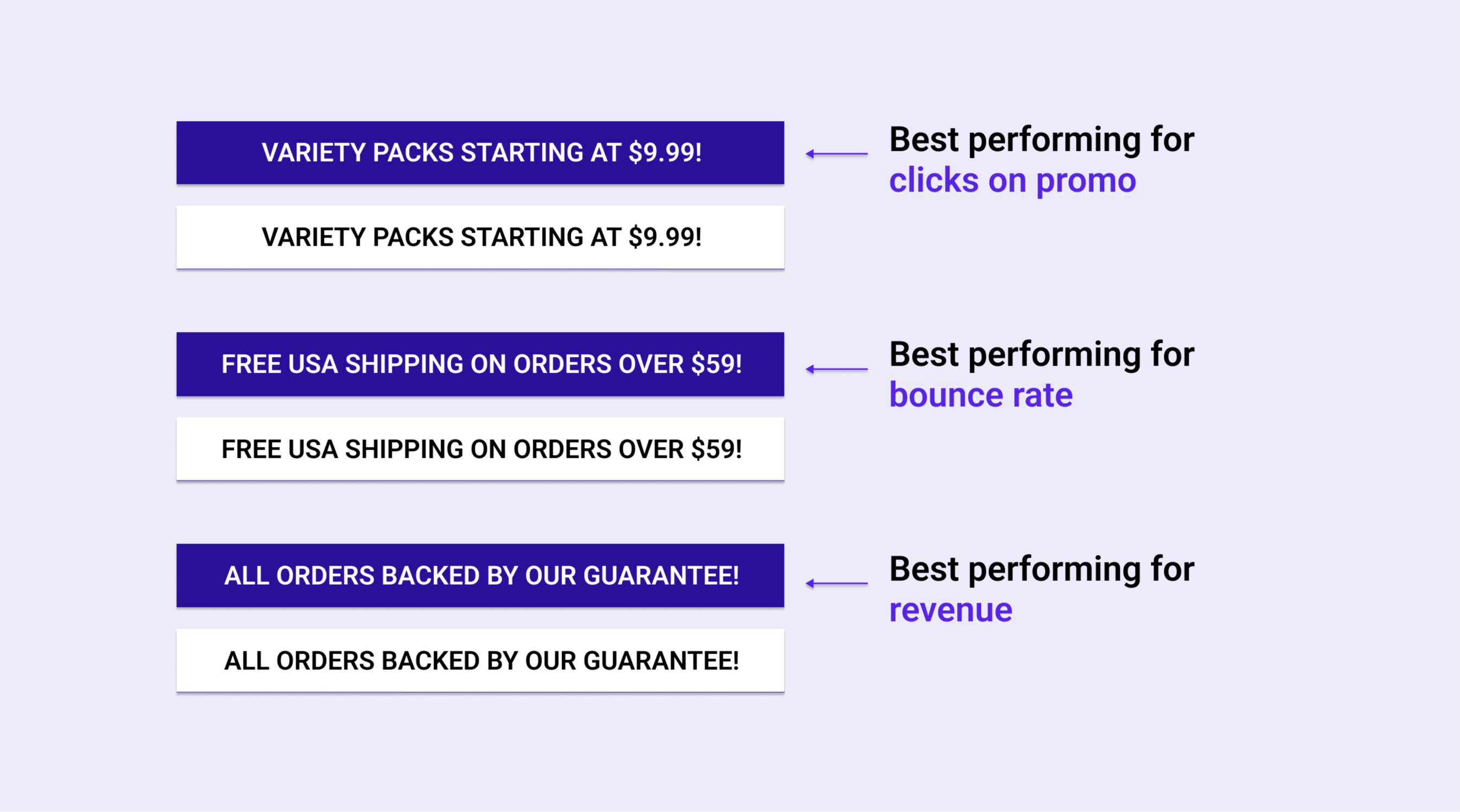
The recent A/B test involved testing three different versions of a promo bar with varying colors and messaging. Here is what we found:
Color Impact: The purple promo bar consistently outperformed the more subtle white bar in overall engagement. This aligns with general marketing psychology- bold, contrasting colors tend to draw more attention and increase click-through rates.
Messaging Impact:
Variety Pack Messaging: Increased clicks by 574.9%
Free Shipping Messaging: Decreased bounce rate by 1.76%
Scratch Guarantee Messaging: Increased revenue by 10.73%
Each variation had a different impact, demonstrating that messaging influences specific outcomes. If the company’s goal was to get more clicks, the variety pack messaging would be the best option. However, if they wanted to reduce their bounce rate and keep customers on their site longer, the free shipping messaging would be more effective. Finally, if revenue was a priority, the scratch guarantee messaging had the greatest impact.
When conducting an experiment, often people believe that revenue seems like the obvious choice of a primary goal, but it isn’t that simple. Increasing revenue conversion rates simply means more people checked out. However, it doesn’t necessarily correlate with average order value (AOV). In this instance, the company wanted to encourage variety pack purchases because they saw a trend that customers who tried a variety sample pack were significantly more likely to become repeat purchasers. This highlights the importance of defining success beyond immediate revenue gains and considering long-term customer value.
The Importance of Tracking the Right Goals
Many times, companies run A/B tests without a clear understanding of what they want to achieve. They might test different CTA button colors, headlines, or promo messages, but fail to define the key metric they are typing to improve. This can lead to misleading conclusions and poor decision-making,
Here is why tracking the right goals is essential for success:
1. Different Tests Drive Different Outcomes
Not every A/B test is designed to increase revenue directly. Some tests are meant to improve engagement, reduce bounce rates, or increase the average order value. Before running an experiment, businesses must identify their primary objective.
For example:
If the goal is to drive more clicks, testing compelling messaging and high-contrast design elements is ideal.
If the goal is to decrease bounce rates, messaging that emphasizes trust factors like free shipping or easy returns may be more effective.
If the goal is to increase revenue, testing product bundles, discounts, or urgency-driven copy might yield the best results.
2. Misaligned Goals Can Lead to Misinterpretation
Imagine a company testing a new CTA button and seeing a massive increase in clicks. They might assume the test was successful. However, if that increase doesn’t translate to revenue, was the test truly a success? A/B tests should be evaluated based on how well they align with the intended business goal.
3. Data-Driven Decisions Reduce Guesswork
Without a clear goal, businesses may rely on gut feelings when interpreting test results. A structured, goal-oriented approach ensures that every experiment provides actionable insights that lead to tangible improvements.
How Compose Helps Businesses Track the Right Goals
At Compose, we designed our A/B testing platform to help e-commerce businesses run smarter experiments that align with tier objectives. Here’s how we ensure businesses track and optimize for the right goals:
1. Customizable Goal Tracking
With Compose, businesses can set specific goals for each test–whether it’s increasing conversions, reducing bounce rates, or improving engagement. Our platform provides real-time insights, allowing companies to measure the right KPIs based on their unique business objectives.
2. Experimentation for All Technical Levels
Many businesses shy away from A/B testing due to technical limitations. Compose removes this barrier by offering an intuitive platform that enables teams to easily set up and deploy experiments with or without developer resources.
3. Detailed Performance Insights
Beyond just showing which variation “won,” Compose provides granular insights into how each variation impacts different metrics and allows users to retroactively filter results to analyze data trends within audience segments. This helps businesses understand not just what worked, but why it worked and how to apply those learnings to future tests.
4. Seamless Integration with E-Commerce Platforms
Compose integrates directly with Shopify, making it easy for e-commerce brands to test product page layouts, messaging, call-to-action elements, and more. With our no-code split theme and template tests utilizing Shopify’s Theme Editor, businesses can quickly launch experiments and optimize their store’s performance without requiring developer resources. Our seamless implementation ensures that testing doesn’t disrupt the customer experience.
Key Takeaways: How to Run Effective A/B Tests
To get the most out of A/B testing, businesses should follow these best practices:
Define Your Primary Goal Before Testing: Whether it’s revenue, engagement, or retention, having a clear objective ensures the right metrics are being tracked.
Test One Variable at a Time: This helps isolate what’s driving the results, making it easier to apply insights.
Analyze Results in Context: A higher click-through rate doesn’t necessarily mean success; look at how changes impact the overall conversion funnel.
Use Data to Inform Future Tests: A/B testing is an ongoing process; each test should provide insights that fuel continuous improvement.
A/B testing is a powerful tool, but its effectiveness depends on tracking the right goals. As the promo bar experiment demonstrated, different tests yield different outcomes, and success is only meaningful if it aligns with the desired business impact.
With Compose, e-commerce businesses can confidently run experiments that drive real, measurable improvements. By making data-driven decisions, companies can unlock higher conversion rates and create a more optimized shopping experience for their customers.
Interested in maximizing your website conversions and tracking the right goals? Start testing with Compose today!